
People talk about “moving to Italy” like it’s mainly a logistics problem: visa, house hunt, shipping container, done. But after watching dozens of friends and acquaintances make the leap, the truth settles in fast—geography is the smallest part. What you’re really choosing is a life. The location just happens to be the backdrop for the bigger bet slot depo 5 ribu.
The decision isn’t triggered by a postcard view of Tuscany or a viral reel of Amalfi. It starts earlier, in quiet moments when you ask yourself: what kind of days do I actually want? Do I want mornings that begin with silence instead of alarms? Do I want meals that matter more than meetings? Italy doesn’t sell you a fantasy escape; it quietly offers a framework for answering those questions differently—a slow spin that rewards intention over impulse.
Most relocations fail not because of bureaucracy or culture shock, but because the person never clarified what life they were chasing. They packed excitement, not intention. Italy rewards the ones who arrive with a clear sense of what they’re trading speed and scale for—the quiet jackpot of depth over endless hustle.
The Mindset Pivot Comes First
Before you even look at property listings, the real work is internal. You have to decide that “better” doesn’t always mean bigger, faster, or more connected. It can mean quieter, deeper, slower. That shift sounds romantic until you live it—then it’s just practical, a deliberate pull on the lever.
People who thrive here usually share a few mental habits. They stop measuring success by output volume. They start valuing presence over productivity. They accept that some inefficiency (long lunches, afternoon closures, winding conversations) actually protects what matters: relationships, health, sanity. It’s not anti-ambition; it’s redefining what ambition serves—a bet on human rhythm over machine-like spin.
If you’re still wired to optimize every hour, the Italian pace can feel like failure at first. Then one day you realize you’ve gone a week without checking email after 6 p.m., and nothing collapsed. That’s when the mindset locks in. The location didn’t change you—the decision to prioritize a different reel did.
Geography Supports, But Doesn’t Create, the Life
Italy’s villages, small cities, and countryside make the chosen life easier to sustain, but they don’t invent it. You could chase the same values in rural Portugal or coastal Greece. What makes Italy stand out is how unapologetically it normalizes them—like a reel that’s already set to slow and won’t be rushed.
Take the daily structure. In many places, working from home means blurring lines until you’re always “on.” Here, the culture still draws hard boundaries: shops close, people eat together, evenings belong to passeggiata. The environment gently enforces what you’ve already decided you want. If your internal compass points toward connection over constant availability, Italy amplifies that signal instead of drowning it in noise.
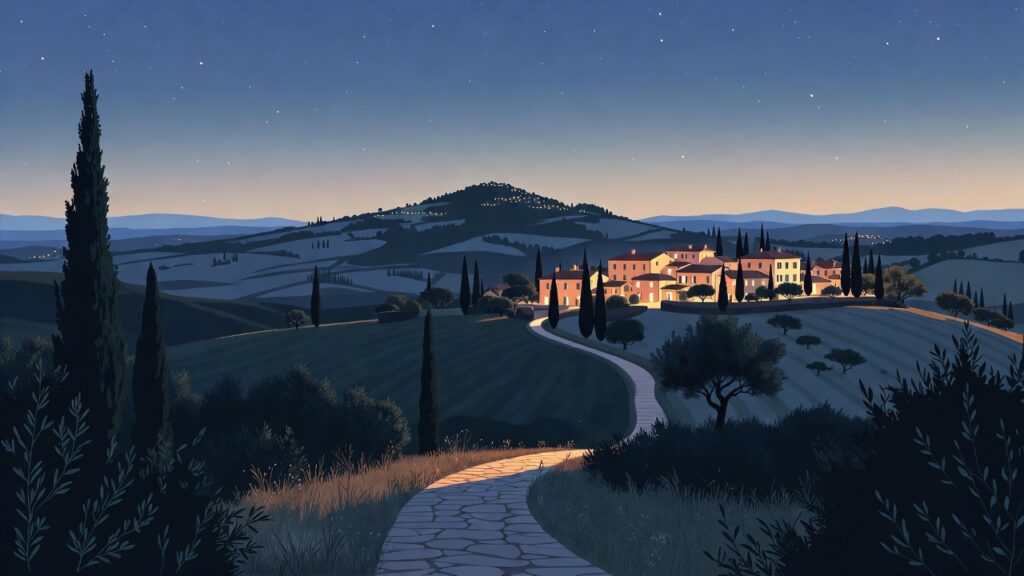
The landscape helps too. Hills and valleys naturally slow movement. You walk more, drive less, notice seasons more. Those physical cues reinforce the mental ones. But strip away the scenery and the core choice remains: are you willing to live at a human tempo, even when the world around you keeps spinning faster? To really feel what that tempo looks like in practice—long lunches, quiet evenings, no constant rush—check out Why Italy Represents a Different Pace of Life. It paints the picture without any hype, just straight observation.
Facing the Trade-Offs Honestly
No one should romanticize this. Choosing this life means giving up things: career velocity in certain fields, instant access to everything, the buzz of constant novelty. You trade scale for depth. You trade convenience for authenticity—a payout that feels richer only after you’ve committed.
The people who last understand that trade-off upfront. They don’t move expecting Italy to fix everything—they move because they’ve already decided what’s worth fixing in their own lives. The ones who struggle are usually the ones who thought location alone would do the heavy lifting, without pulling the right lever first.
It’s okay if the answer is “not yet” or even “not for me.” The point isn’t to sell everyone on Italy. It’s to recognize that relocation is a referendum on your values. Where you end up is secondary to what kind of existence you’re voting for.
Roots Grow from Decisions, Not Addresses
Once the mindset settles, the practical steps—finding a house, learning the language, building routines—become tools, not obstacles. You’re no longer shopping for a pretty view; you’re curating a life that matches the internal shift you’ve already made—a steady spin toward alignment.
That’s why so many who relocate here talk about “finally feeling at home” even when they’re thousands of kilometers from where they grew up. The address didn’t create belonging. The deliberate choice did—the one pull that reshaped everything.
If you’re at that crossroads right now, don’t rush the map. Spend time with the question: what life am I actually choosing? Italy will still be here when you’re ready. And when you arrive with intention instead of just a suitcase, the place starts to feel less like a destination and more like a lifelong win.
Wondering how people actually put down those roots once the decision is made? The thoughts in Building Roots in Italian Villages explore the next phase without glossing over the real work.