
There’s a moment that happens to almost everyone who spends real time in rural Italy: you catch yourself doing absolutely nothing, and instead of panicking, you feel… fine. Maybe you’re sitting on a stone bench in a tiny piazza, watching an old man water flowers while his dog naps in the sun. No agenda, no timer, no guilt. The world keeps turning, but here it turns slower—like a reel that’s finally allowed to spin at its own rhythm.
Italy hasn’t forgotten how to let a day unfold without forcing the lever. Most of us live in places where speed is the default setting. Everything is engineered for efficiency: 15-minute cities, two-minute noodles, instant replies. Then you land in a place like rural Piedmont or Sicily’s interior, and suddenly the clock feels optional. Shops close for three hours at lunch because people actually eat lunch. Conversations stretch because there’s no next pull pressing. It’s not that Italians are lazy—it’s that they’ve decided some things are worth more time than others, worth betting on for the long-term payout.
This different pace of life in Italy isn’t a trendy wellness hack. It’s baked into the culture, the landscape, and the way people have lived for centuries. And once you experience it, the contrast with the rest of the modern world becomes almost uncomfortable—like stepping off a fast-spinning machine and realizing you’ve been chasing the wrong jackpot all along.
The Roots of Slow: Tradition Over Trend
Italy’s slower tempo comes from deep historical roots tied to the land. Farming communities didn’t have the luxury of rushing seasons—grapes ripen when they ripen, wheat is harvested when it’s ready. You wait. You adapt. That patience carried over into daily life. Meals became long because they were the main social event of the day—the real payout. Siesta wasn’t laziness; it was survival in a climate where the afternoon sun could be brutal.
Even now, in villages across Tuscany, Umbria, or Puglia, you see echoes of that rhythm. Families still gather for pranzo as the centerpiece of the day. Grandparents teach kids to knead dough by hand because the machine version never tastes the same. These aren’t performative “slow living” trends—they’re just how life has always spun here. Trying to speed it up feels like swimming against the current, fighting a reel that’s already locked in for generations.
What makes it powerful is the lack of apology. There’s no defensive “sorry, we’re closed for riposo.” It’s simply understood that humans need breaks, conversations, and real food. In a world obsessed with optimization, that refusal to hurry is quietly radical—a steady bet on human rhythm over endless spin cycles.
Nature Sets the Clock
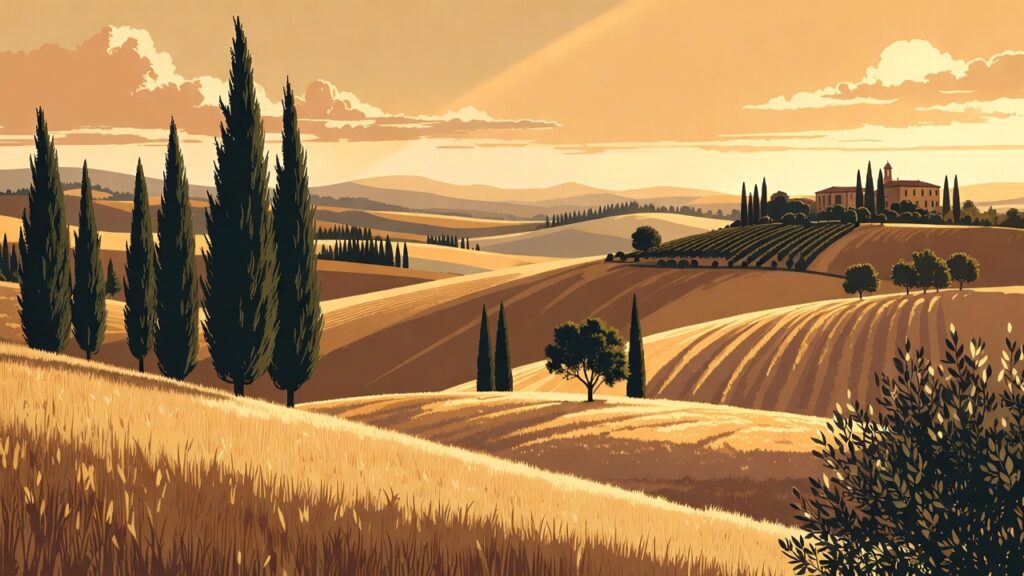
The Italian countryside itself enforces a slower cadence. Narrow roads wind around hills instead of cutting straight through them. You can’t drive 100 km/h because the turns won’t let you. Views pull your attention—vineyards cascading down slopes, olive groves silver in the breeze, medieval hamlets perched like they’ve been there forever. The landscape demands you slow down to actually see it, to let the reel play out naturally.
People live in sync with that environment. Laundry dries in the sun because electricity isn’t free. Gardens are tended by hand because that’s how you get the best zucchini. Even the architecture plays a role: thick stone walls keep houses cool without air conditioning, so you open windows in the morning and close shutters at midday. Life is shaped around natural cycles, not artificial ones—pure momentum from the land itself.
That alignment creates a sense of being grounded. You’re not racing through abstract to-do lists—you’re moving with the light, the temperature, the seasons. It’s a reminder that for most of human history, this was normal. Modern life sped everything up; Italy just never fully caught the memo on the fast pull.
What Changes When You Let the Pace Shift
Visitors usually arrive wired. They book tight itineraries, wake up early to “maximize” the day, eat standing up because that’s efficient. Then something cracks open. Breakfast turns into 40 minutes at the bar with a second cappuccino because the barista is telling a story. You walk instead of drive because the village is small and beautiful. You leave your phone face-down during dinner because the people across the table are more interesting.
The shift isn’t dramatic at first. It’s subtle. You notice you’re breathing deeper. Conversations last longer without feeling forced. You start enjoying silence instead of filling it. By the end of a week, the idea of rushing back to a packed schedule feels almost absurd—like cashing out a winning streak too early and missing the bigger payout.
Of course, it’s not utopia. Wi-Fi can vanish for hours, trains run late, and getting simple paperwork done can test your patience. But those annoyances fade when weighed against the space you suddenly have—space to think, to rest, to actually taste your food. Many who come for a holiday end up staying years because they realize this pace isn’t holding them back; it’s setting them free with a quiet, lifelong win.
And once you start wondering how people actually decide to make that permanent shift—trading the old rush for this quieter rhythm—the next question worth asking is how to choose the life itself, not just the postcard spot. Choosing a Life, Not Just a Location digs right into that mindset pivot without any fluff.
A Quiet Argument for Living Differently
Italy’s different pace of life isn’t trying to convert anyone. It simply exists as proof that another way is possible. You don’t have to quit your job or sell everything to feel it—just spend enough time here to let the rhythm seep in. The long lunches, the evening passeggiata, the way nobody apologizes for taking their time—they all whisper the same thing: life doesn’t have to be a sprint to be meaningful. It can be a slow, deliberate spin that actually pays off over time.
If you’ve ever felt the weight of constant acceleration and wondered whether there’s room to step off the treadmill, Italy offers a living example. Not as an escape, but as an alternative that’s been working for generations—one steady pull at a time.
Curious about the actual decisions people make to embrace this slower rhythm? Take a look at The Life Choices That Lead to Italy. It digs into the real steps behind choosing this path.